Ish and Em decide to have a child
Earth AbidesIsh and Em decide to have a child not because they settle the abstract question of humanity’s duty to the future, but because Em wants a baby and Ish comes to accept the risk of beginning again. Their decision turns a discussion about whether life ought to continue into an intimate commitment: Em’s courage gives Ish the confidence to act, and a later exchange suggests that she believes the attempt has succeeded.
The Question They Had Avoided
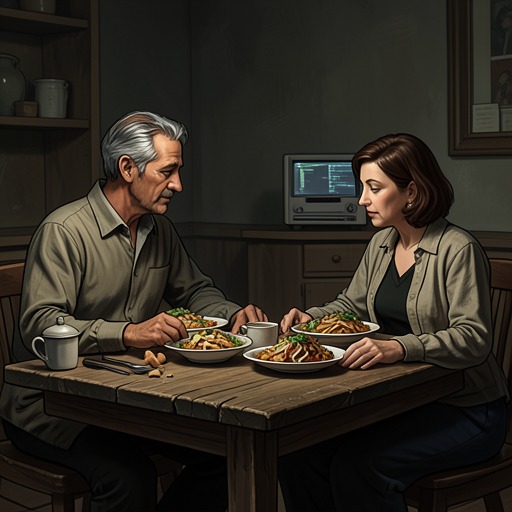
The decision emerges during a quiet scene in the living room. Em rests her head in the crook of Ish’s arm as they lie on the davenport in the twilight. He knows there is one question they have not faced; she is the one who brings it forward. The setting is domestic and close, but the question reaches far beyond their household: whether they should bring a child into a world in which the old civilization has collapsed and the future is uncertain.
Ish approaches the subject through biology and obligation. He asks whether having children is natural, whether life must go on, and whether they owe something to the future. Em does not offer a philosophical argument. She admits uncertainty about whether life needs to continue at all, then distinguishes her actual wish from the grander justification: she wants a baby for herself. She also says that she finds it difficult to express what she thinks, and turns from explanation toward affection. Her answer makes the choice personal without pretending that its consequences are small.
The Match and the Meaning of Life
Em’s difficulty with words becomes part of how the scene communicates. She takes a large kitchen match from the box on the table. Though she smokes more than Ish, she does not take a cigarette. She turns the match between her fingers, strikes it, watches the flare subside into a steady yellow flame, and then blows it out. Ish understands the gesture as an attempt, perhaps only partly conscious, to express what she cannot readily put into speech.
The match gives him an image for the decision. It is alive, in the sense that matters to him, while it burns; it cannot burn forever. He draws the analogy between the brief flame and human life, arriving at the conviction that life is not lived by denying its limits. The gesture does not answer whether the future is guaranteed or whether humanity has a duty to survive. Instead, it alters the terms of the choice: mortality is no reason to refuse life while it is present. Em’s small, extinguished flame thus helps turn Ish’s abstract hesitation into an acceptance of finite, vulnerable existence.
Ish’s Hesitation and Em’s Courage
Ish does not reach agreement without resistance. He remembers his earlier fear in the desert and the exhilaration he felt when he unlashed the motorcycle from the station wagon’s tail-gate and threw it aside. That earlier defiance had confronted death and darkness in a dramatic moment; by contrast, he recognizes Em’s courage as part of daily life. The comparison shifts the scene’s emphasis away from heroic mastery. Ish’s resolve is not self-sufficient: he is moved by the steady courage of the person beside him.
He first agrees to read the books, a practical response to the questions of biology and parenthood. Em answers that she may need more help than that. Ish remains held back for a moment by loneliness, emptiness, and terror. He wonders who he is to set mankind once more on its long, uncertain road. Then, as the passage describes it, Em’s courage and confidence flow from her to him. His inward image of her as the mother of nations expresses the scale he now gives her personal wish: a child would link their intimate life to humanity’s possible future, even though neither can control what that future becomes.
Acceptance and Its Consequence
The scene’s decisive movement is not a proof that life must continue. Em has explicitly resisted making her wish depend on such a proof, and Ish’s fear does not vanish through argument. Instead, he accepts her desire and lets her confidence carry him past his hesitation. The decision belongs to both of them, but the exchange preserves the difference between their positions: Ish approaches parenthood through books, duty, and fear of responsibility, while Em speaks from an immediate desire she admits she cannot fully explain.
Later, the narrative returns to the couple with Em’s head again in the crook of Ish’s arm. The passage immediately before this moment has imagined the human order ending without a capable successor, giving her ensuing remark a sharp counterpoint. She tells Ish that he had better get busy with his book-work, then says, "I guess it's happened." The remark suggests that she believes she is pregnant, though the scene offers no further confirmation here. It gives the earlier decision a possible consequence: what began as a question about whether life should go on has become, at least for Em, the beginning of a particular life.
Significance
The episode joins reproductive hope to an acceptance of mortality without treating a child as a guaranteed restoration of civilization. Ish fears the burden of placing mankind back on an uncertain road; the match teaches him that uncertainty and finitude do not make life worthless. Em’s wish remains both personal and consequential: she wants a baby for herself, while the prospect reaches toward a human future beyond the two of them. The later suggestion of pregnancy keeps that future concrete but unresolved, preserving the distinction between choosing to begin and knowing what will follow.